


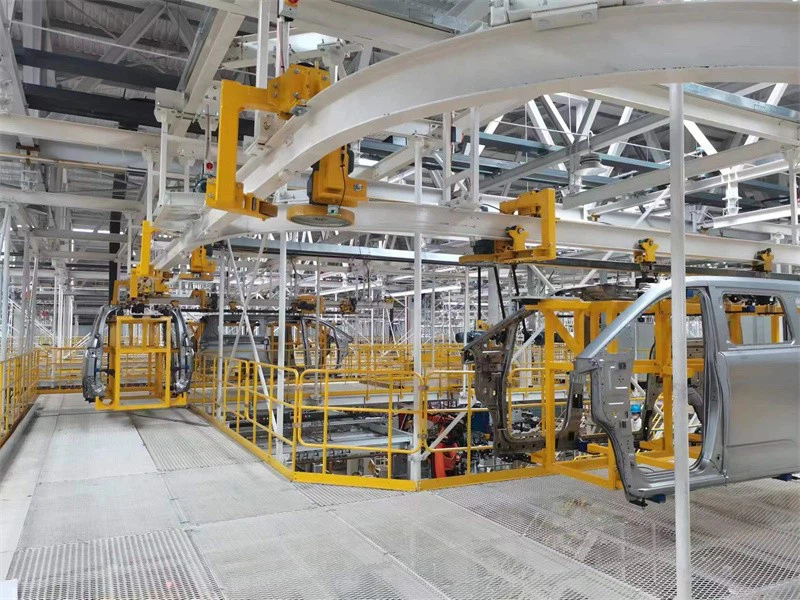


product features
1.Simple and space-saving: driven by friction, no complex structures like gears. Few components, compact layout, and small space occupation.
Strong adaptability
2.Handles various product shapes (regular/irregular) and materials without custom fixtures.
Suits both small-batch multi-variety and large-batch conveying; easy to adjust for product size.
3.Gentle and stable conveying
Soft friction avoids rigid impacts, protecting fragile or surface-sensitive goods.
Speed is easy to control, with low vibration and noise for stable operation.
4.Flexible layout
Can be horizontal, inclined, or curved to fit workshop spaces.
Easily integrates with other automated equipment (e.g., robotic arms) for seamless production lines.
Product advantages
|
Advantage Dimension |
Friction Conveyor |
Roller Conveyor (Typical) |
Belt Conveyor |
|
1. Handling of Irregular/ Fragile Goods |
Strongest: Soft friction avoids rigid contact; ideal for irregular parts |
Weak: Hard roller surface risks damaging fragile goods; struggles with irregular shapes that can't sit stably. |
Moderate: Good for fragile goods but limited by belt width; irregular items may slip or get stuck. |
|
2. Space & Layout Flexibility |
Strong: Compact structure (no large rollers/belts); easy to design as curved or inclined conveyors for narrow spaces or obstacle-bypassing. |
Moderate: Horizontal layout is space-efficient, but curved/inclined designs need more support structures. |
Weak: Long belts require large tensioning spaces; curved layouts are difficult and take up more room. |
|
3. Maintenance & Cost |
Moderate to Strong: Fewer wearing parts (no roller bearings/belt joints); low maintenance cost; initial investment is lower than belt/chain conveyors. |
Moderate: Many roller bearings need regular lubrication; maintenance frequency is higher than friction conveyors. |
Weak: Belts are prone to wear/tear and need replacement; high maintenance and replacement costs. |
|
4. Adaptability to Product Size |
Strong: No need for custom fixtures; easy to adjust friction component spacing for different-sized products. |
Moderate: Requires changing roller spacing or adding guides for different sizes; less flexible. |
Weak: Fixed belt width; can't handle products wider |
Product Specification
|
Parameter Category |
Specific Item |
Typical Value Range |
|
Load Capacity |
Light/Medium-Duty (e.g., Series 3800) |
Up to 500 N |
|
Heavy-Duty (e.g., Series 3880) |
Up to 2400 N |
|
|
Conveying Performance |
Maximum Speed |
0.5 m/s (common standard) |
|
Coefficient of Friction |
0.12–0.35 (varies by material) |
|
|
Acceleration |
~0.2g |
|
|
Structural Parameters |
Roller Tube Diameter |
50 mm–60 mm (medium-duty); custom for heavy-duty |
|
Spindle Diameter |
12 mm–15 mm |
|
|
Curved Layout Radius |
Customizable (≥ 300 mm typical) |
|
|
Drive System |
Drive Types |
Flat belt, toothed belt, chain |
|
Drive Control |
Adjustable speed via motor frequency conversion |
|
|
Environmental Adaptability |
Temperature Range |
-5 °C to +40 °C |
|
Anti-Static Performance |
Anti-static type optional |
|
|
Operational Features |
Noise Level |
Low (≤ 65 dB) |
|
Maintenance Cycle |
6–12 months (routine inspection) |
Application
Automotive Parts Manufacturing
Electronics & Electrical Appliance Industry
Packaging & Logistics Sorting
Light Manufacturing (Furniture, Hardware)
after-sale service
Response speed: Provide 24/7 online technical support (phone, video call). For urgent faults (e.g., conveyor shutdown), assign local service engineers to arrive on-site within 4–8 hours (for Tier 1/2 cities) or 12–24 hours (for remote areas).
On-site service scope: Include fault diagnoses (e.g., friction wheel wear, drive motor failure), replacement of core parts (with original spare parts), and post-repair performance testing to ensure the conveyor restores to ≥95% of initial efficiency.
FAQ
|
Q: How to apply for warranty service for core components? |
|
A: Provide 3 materials to our after-sale team (email: [cdjlssj@163.com]): ① order number; ② photos/videos of defective parts; ③ maintenance record (if any). We will confirm eligibility within 24 hours and arrange free replacement. |
|
Q: What if online technical support can't solve my problem? |
|
A: After 2 rounds of online guidance (e.g., video call, step-by-step docs), if the issue remains, we will book on-site service. The arrival time depends on your location: 3 working days for major cities, 5 working days for remote areas. |
|
Q: Are wear parts (e.g., trolley wheels) covered by warranty? |
|
A: No. Wear parts are excluded from the 12-month core component warranty, as their wear is related to usage frequency. But we offer 10% discount on wear parts for warranty-period customers. |
Hot Tags: friction drive conveyor, China friction drive conveyor manufacturers, suppliers, factory, friction conveyor for shipping, friction conveyor for diverting, friction conveyor for pharmaceutical industry, friction conveyor with variable speed, friction conveyor with cost effective, friction conveyor installation


