

Hey there! As a supplier of Friction Drive Conveyors, I often get asked about the maximum load capacity of these conveyors. It's a crucial question, especially for businesses looking to optimize their material handling processes. So, let's dive right in and explore what determines the maximum load capacity of a friction drive conveyor.
First off, what exactly is a friction drive conveyor? Well, it's a type of conveyor system that uses friction to move products along a path. Unlike other conveyor types that rely on chains, belts, or gears, friction drive conveyors use the force of friction between the drive wheels and the conveyor surface to transfer power and move items. This design offers several advantages, such as smooth operation, low noise, and the ability to handle a variety of product shapes and sizes.
Now, back to the main question: What's the maximum load capacity? The answer isn't as straightforward as you might think. Several factors come into play when determining how much weight a friction drive conveyor can handle.
Factors Affecting Load Capacity
1. Conveyor Design
The design of the conveyor itself plays a huge role in its load - carrying capacity. The size and strength of the frame are important. A sturdier frame made of high - quality materials like heavy - gauge steel can support more weight. For example, a conveyor with a wide and thick frame is less likely to bend or deform under heavy loads compared to a flimsy one.
The number and size of the drive wheels also matter. More drive wheels distribute the load more evenly, allowing the conveyor to handle heavier items. Larger drive wheels can also provide more traction and power, which is essential for moving heavy loads smoothly.
2. Friction Material
The material used to create the friction surface on the drive wheels and the conveyor bed is critical. Different materials have different coefficients of friction. A material with a high coefficient of friction can grip the products better, enabling the conveyor to move heavier loads. For instance, rubber - like materials are often used because they offer good friction and can withstand wear and tear.
3. Speed of Operation
The speed at which the conveyor operates can impact its load capacity. Generally, slower - moving conveyors can handle heavier loads than those running at high speeds. When a conveyor moves too fast with a heavy load, there's a greater risk of the products slipping or the conveyor components wearing out quickly. So, if you need to move really heavy items, it might be better to set the conveyor at a lower speed.
4. Product Characteristics
The nature of the products being transported also affects the load capacity. Items with a large surface area in contact with the conveyor bed distribute their weight more evenly, making it easier for the conveyor to handle them. On the other hand, products with a small contact area or an irregular shape might put more stress on certain parts of the conveyor, reducing its overall load - carrying ability.
Calculating the Maximum Load Capacity
To figure out the maximum load capacity of a friction drive conveyor, engineers usually use a combination of theoretical calculations and real - world testing. They start by considering the factors I mentioned above and use mathematical models to estimate how much weight the conveyor can support.
However, these calculations are just a starting point. In the real world, things can be a bit more complicated. That's why manufacturers like us conduct extensive testing with different types of loads to verify the calculated load capacity. We run the conveyor with various weights and monitor its performance, looking for any signs of stress, wear, or malfunction.
Real - World Examples
Let's take a look at some real - world scenarios to understand the load capacity better. In a food processing plant, a friction drive conveyor might be used to move boxes of canned goods. These boxes are relatively light and have a regular shape, so the conveyor can handle a relatively high volume of them. The load capacity in this case might be in the range of a few hundred pounds per linear foot.
On the other hand, in a manufacturing facility that produces heavy machinery parts, the conveyor needs to move large and heavy components. Here, the load capacity could be several thousand pounds per linear foot, but the conveyor would need to be specially designed with a robust frame, large drive wheels, and high - friction materials.

Importance of Knowing the Load Capacity
Understanding the maximum load capacity of a friction drive conveyor is crucial for several reasons. First of all, it helps businesses choose the right conveyor for their needs. If you underestimate the load capacity, the conveyor might break down frequently, causing costly downtime. On the other hand, overestimating it means you might end up spending more money on a larger and more expensive conveyor than you actually need.
It also ensures the safety of the workers and the integrity of the products. A conveyor overloaded beyond its capacity can pose a serious safety hazard, such as collapsing or ejecting products. And damaged products can lead to financial losses and dissatisfied customers.
Our Friction Drive Conveyors
As a supplier, we offer a wide range of friction drive conveyors with different load capacities to meet the diverse needs of our customers. Whether you're in a small workshop or a large industrial plant, we have a solution for you.
Our Friction Drive Conveyor models are designed with the latest technology and high - quality materials. We use advanced engineering techniques to ensure that our conveyors can handle heavy loads efficiently and reliably.
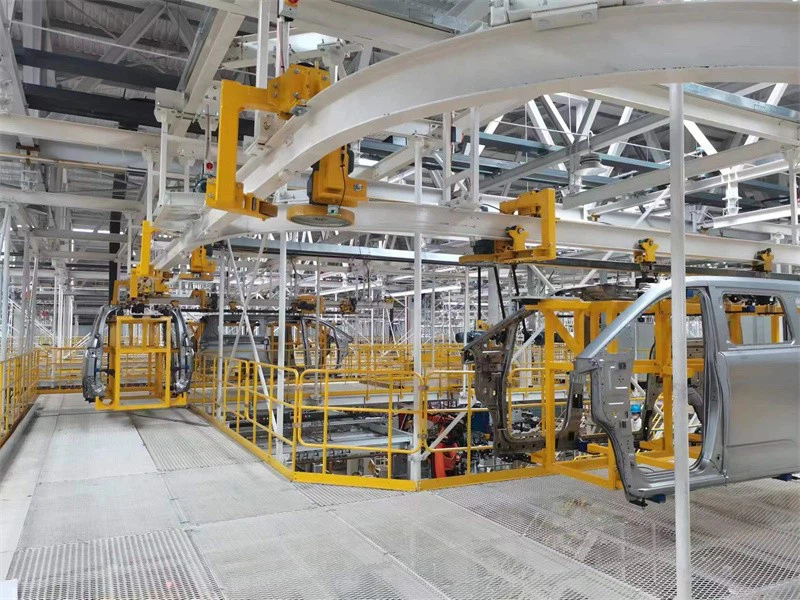
If you're dealing with overhead transportation, our Friction Overhead Conveyor is a great option. It's designed to move products overhead, saving valuable floor space and providing a flexible material handling solution.
Contact Us for Your Conveyor Needs
If you're interested in learning more about the load capacity of our friction drive conveyors or need help choosing the right conveyor for your business, don't hesitate to reach out. We have a team of experts who can answer all your questions and guide you through the selection process. Whether you're just starting to plan your material handling system or looking to upgrade an existing one, we're here to assist you.
In conclusion, the maximum load capacity of a friction drive conveyor is determined by a variety of factors, including its design, the friction material, the speed of operation, and the characteristics of the products being transported. By understanding these factors and working with a reliable supplier like us, you can ensure that you get a conveyor that meets your specific needs and performs well for years to come.
References
- "Conveyor Systems Handbook" by Conveyor Equipment Manufacturers Association
- "Material Handling Engineering" textbooks from leading engineering publishers